Stockholm Through Stieg Larsson
I’d wanted to come here ever since reading the Millennium trilogy — it was simply too gripping and cinematic to resist. Then came the screen adaptations of the Lisbeth Salander novels, and the urge only grew stronger. But there was always something else, or I was being pulled somewhere else entirely. Until, in the summer of 2019, I had a thought (this is exactly how my best journeys are born): where might I see Midsommar — the Summer Solstice festival? It tends to be celebrated most vividly in Northern countries. The choice was between Norway and Sweden. Since direct flights, for now, only run to the latter, the answer became clear: time to head to Stockholm… And so I finally made it to the home of one of my most beloved literary universes.
How do we fall in love with a particular book? Literary “butterflies in the stomach” are born at the moment when you’re fully immersed in the atmosphere of the work, when you want to say “I believe!”, and a thought slips in unbidden: I should have written this. That’s how it was for me with Stieg Larsson’s books.
The author, who died untimely young, had reportedly intended to write not a trilogy about Lisbeth Salander but as many as ten novels. There are even said to be drafts of some kind. And perhaps one day someone will rework them… But we all understand: no one can continue the story the way the real author could.

So all that’s left is to re-read what we have, re-watch the adaptations — and wander Stockholm, recognising the places we’d mentally followed the characters through in The Girl with the Dragon Tattoo, The Girl Who Played with Fire, and The Girl Who Kicked the Hornets’ Nest.
The working-class districts
At the heart of Larsson’s novels are two main characters: that mysterious, extravagant, extraordinary hacker Lisbeth Salander, and the journalist Mikael Blomkvist. It’s commonly held that Blomkvist was modelled on the author himself — also an investigative journalist, who died suddenly at what is, by Swedish standards, a young age of 50. There are theories that this death wasn’t entirely natural…

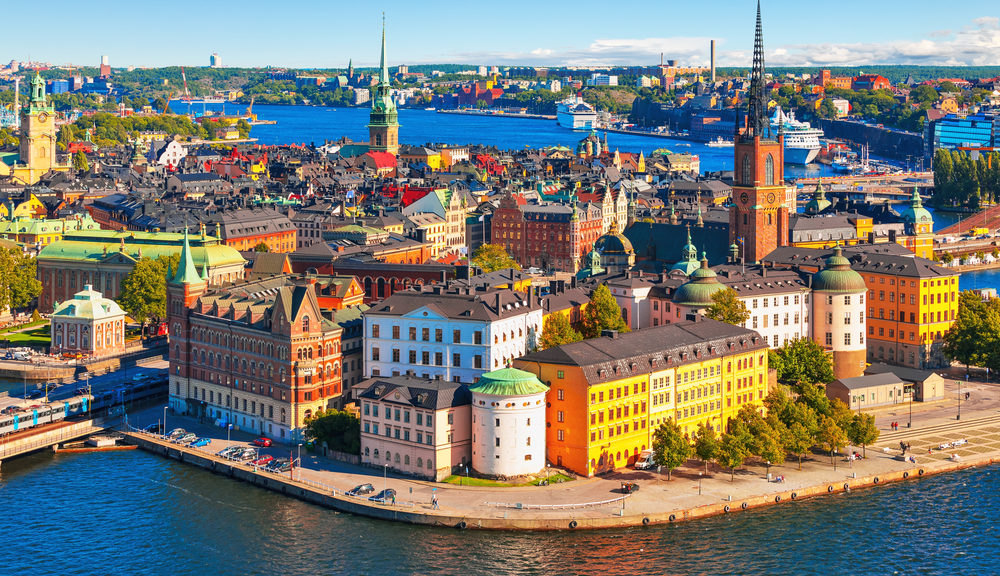
Stieg Larsson himself lived in the Stockholm district of Södermalm — or simply Söder. Historically, this was where workers and people of more modest means settled. The reason: on the island of Gamla (today’s heart of Stockholm — Gamla Stan), where the Swedish capital was first founded, only stone houses had been permitted from the seventeenth century onward, after a series of fires destroyed parts of the city. The poor couldn’t afford this — wooden buildings were their lot. So they had to move further south, to the island of Söder (then known as Åsön).
Today Södermalm is an eclectic district right in the centre of the Swedish capital, home to many landmarks, museums, restaurants and the rest. It was also where Stieg Larsson lived — and worked, as editor-in-chief of the political magazine Expo.

And it was here, too, that he set the homes of his beloved characters: Lisbeth Salander bought herself a 21-room penthouse at Fiskargatan 9, while Mikael Blomkvist’s apartment was at Bellmansgatan 1, not far from the Adat Jisrael Synagogue and the Stockholm Mosque.
Where the wealthy live
Larsson placed the “bad guys” of his novels on the other side of the Riddarfjärden strait — in the more affluent and glittering Östermalm. This is where the unscrupulous millionaire Wennerström from The Girl with the Dragon Tattoolives — on Stockholm’s most expensive street, Strandvägen.
Coffee and food
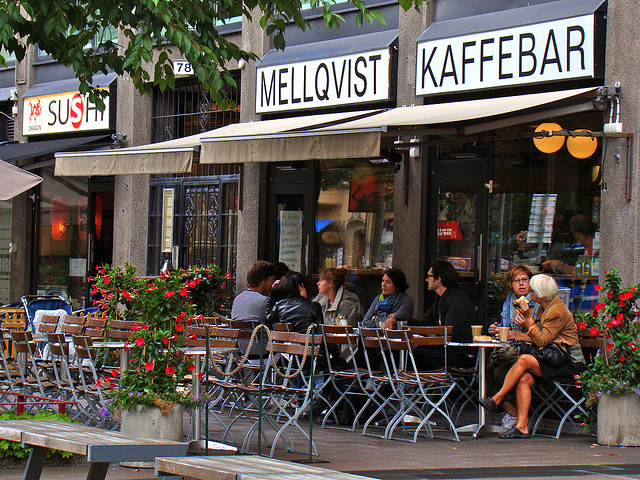
Stockholm’s lively coffee culture rests largely on the Swedish tradition of fika — socialising over a cup of coffee and something baked. Mikael Blomkvist did his “fika-ing” at Mellqvist Kaffebar, a real establishment at Hornsgatan 78 in Södermalm. Stieg Larsson himself, it’s said, could often be found working there with his laptop — the Expo offices were just nearby.
For something more substantial, the journalist-writer reportedly liked the surrounding ethnic restaurants. He used to order lamb stew, for instance, at Tabbouli, a small Lebanese tavern at Tavastgatan 22, which became the prototype for the Bosnian restaurant Samir’s Cauldron, mentioned in the third book of Larsson’s trilogy, The Girl Who Kicked the Hornets’ Nest.
For traditional Swedish cuisine — venison dishes and the famous meatballs — there’s the restaurant-pub-club Kvarnen at Tjärhovsgatan 4, where Lisbeth Salander used to meet the members of her fictional all-girl band, Evil Fingers.
Social and cultural undercurrents
Larsson’s books are interesting not only for their detective plots and rapidly unfolding storylines. They are also full of references to the moods and phenomena that mark contemporary Sweden. And of reminiscences from the past. All the more reason to keep unpicking the threads of his novels.
In the Millennium trilogy, for example, you can find a nod to the work of the great Swedish writer Astrid Lindgren — Lisbeth Salander, after all, can quite easily be read as a grown-up version of the rebel Pippi Longstocking. Perhaps she even dyes her hair black to hide a natural shade of red. And on the door of Lisbeth’s exclusive super-flat, there’s a name plate reading “V. Kulla” — practically “Villa Villekulla,” like Pippi’s house.
And Mikael Blomkvist — isn’t this Kalle Blomkvist from the children’s detective stories Lindgren wrote?

Beyond the geographical distribution of his good and bad guys around the city, Stieg Larsson was also trying to capture the social and cultural divisions and diversity of contemporary Swedish society. It’s worth noting that he himself was pro-immigration — he believed migrants were necessary to his country. And by saying so, he made enemies of those who saw foreigners arriving in Sweden as a threat. Even so, Millennium reflects a fact of modern Stockholm: today, around 25% of the city’s residents are either recent migrants themselves or descendants of those who arrived earlier.
He was apparently planning to develop this theme in the further books of the series — of which there were meant to be ten. Instead, he left behind only three bestsellers.
And a city you want to visit after reading them.